
I’ve stood on enough job sites after a heavy rain to know exactly what unmanaged erosion looks like: muddy runoff cutting channels across bare soil, sediment pooling at the site exit, and a stormwater inlet clogged with silt. It’s not just messy — it’s a compliance failure, an environmental hazard, and often an expensive one to fix after the fact. In this guide, I’ll walk you through how I approach soil erosion prevention on a construction site, from understanding why it happens to the specific controls I put in place before the first shovel hits the ground.
What Is Soil Erosion on a Construction Site, and Why Does It Matter?
Definition and Causes
Soil erosion on a construction site happens when vegetation is cleared and topsoil is exposed, leaving loose sediment vulnerable to being washed away by rain or blown away by wind. Construction activity — grading, excavation, stockpiling — strips away the natural root systems and ground cover that would otherwise hold soil in place.
Why It’s a Serious Problem
I don’t treat this as a cosmetic issue. The scale of the problem is well documented:
| Statistic | Figure | Source |
|---|---|---|
| Sediment runoff rate vs. forest land | 1,000–2,000x greater | EPA |
| Sediment runoff rate vs. agricultural land | 10–20x greater | EPA |
| Soil lost annually from unmanaged sites | Up to 100 tons per acre | EPA |
| Annual environmental damage cost from sedimentation | ~$16 billion | EPA |
| Minimum site size requiring an NPDES permit | 1 acre of disturbed land | EPA/Clean Water Act |
| Share of Minnesota rivers/streams impaired by sediment | ~30% | MPCA |
Sediment runoff rates from construction sites are typically 10 to 20 times greater than runoff from agricultural lands, and 1,000 to 2,000 times greater than runoff from forest lands — and in a short period, construction activity can contribute more sediment to streams than would accumulate naturally over several decades. That single fact changed how seriously I take erosion control on every project, regardless of site size.
Beyond the environmental damage, eroded sediment clogs storm drains, smothers aquatic habitats, and — critically for anyone managing a project — triggers regulatory violations that can halt work and result in fines.
Legal and Regulatory Requirements
NPDES and the Construction General Permit (CGP)
In the US, construction stormwater discharge is regulated under the National Pollutant Discharge Elimination System (NPDES), enforced by the EPA under the Clean Water Act. Any site disturbing 1 acre or more — or part of a larger common development that will eventually exceed 1 acre — must obtain permit coverage, typically through the EPA’s Construction General Permit (CGP) or an authorized state program.
Stormwater Pollution Prevention Plans (SWPPP)
I never start land-disturbing work without a Stormwater Pollution Prevention Plan (SWPPP) in hand. This document outlines the specific erosion and sediment controls I’ll use, inspection schedules, and corrective action procedures. It’s a CGP requirement, and it’s also just good practice — it forces me to think through the site’s drainage patterns before machinery moves in.
Local and State Regulations
Many states and municipalities layer additional requirements on top of federal rules — Georgia’s Erosion and Sedimentation Act and Minnesota’s MPCA program are two examples. I always check local ordinances in addition to federal NPDES requirements, since local rules can be stricter.
Core Principles of Erosion and Sediment Control
I organize every erosion control plan around two distinct goals:
- Erosion prevention – Stopping soil from being dislodged in the first place (mulching, seeding, minimizing disturbed area)
- Sediment control – Capturing soil that has already been dislodged before it leaves the site (silt fences, sediment basins, inlet protection)
I always prioritize prevention over control. It’s far cheaper and more effective to keep soil in place than to catch it after it’s already moving.
Best Practices to Prevent Soil Erosion on a Construction Site
This is my go-to sequence when planning erosion control for a new site.
1. Minimize the Disturbed Area
I only clear and grade what’s necessary for the current phase of work. Leaving undisturbed buffer zones and phasing land clearing dramatically reduces the amount of exposed soil at any given time.
2. Preserve Native Topsoil and Vegetation
Wherever possible, I strip and stockpile topsoil separately for reuse later, and I protect existing vegetation buffers around the site perimeter. Established root systems are one of the most effective erosion controls available, and they’re free.
3. Install Silt Fencing
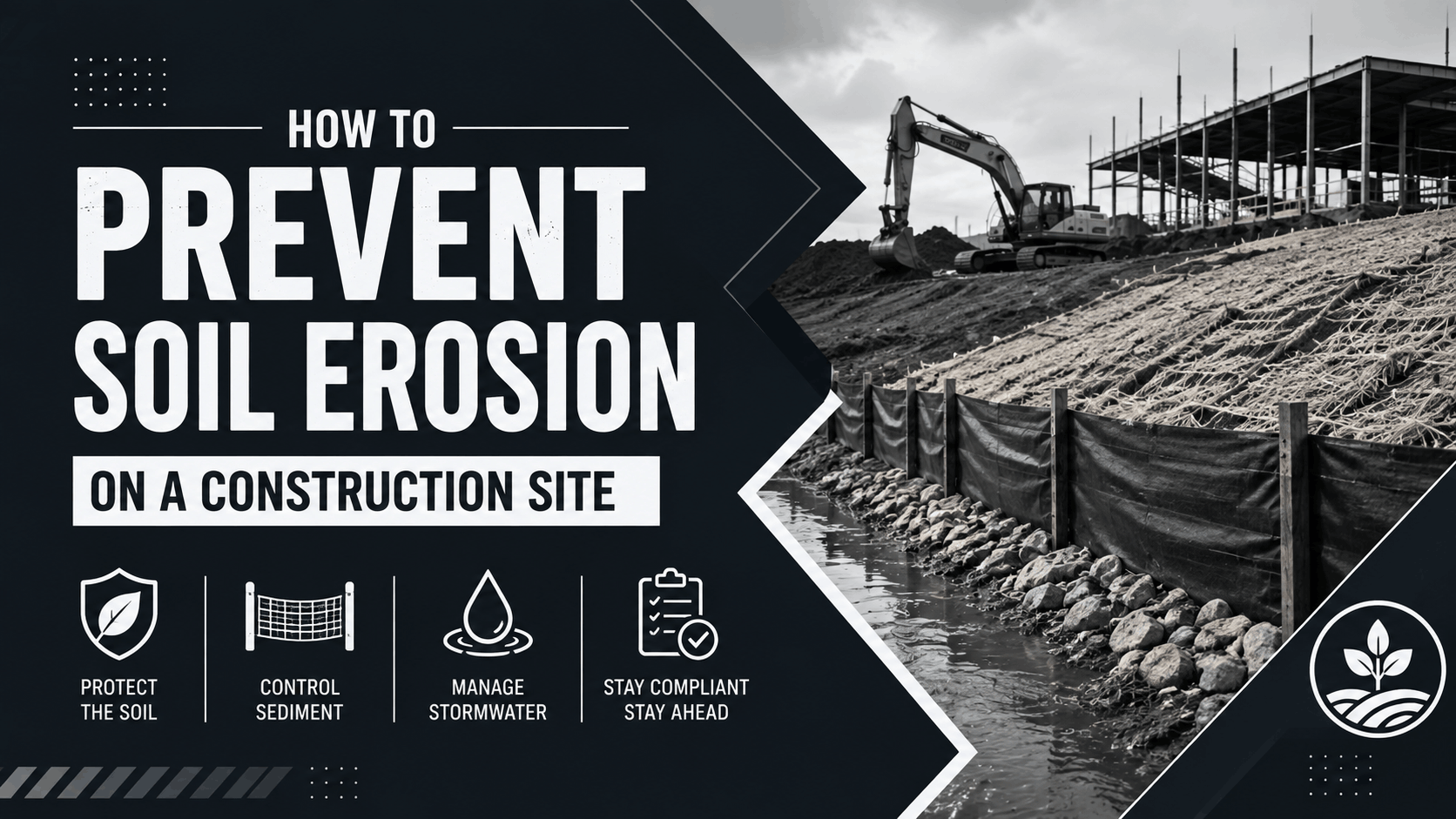
Silt fences are my first line of sediment defense along the downslope perimeter of a site. They’re simple, inexpensive, and effective at trapping sediment-laden runoff before it leaves the property.
4. Use Erosion Control Blankets and Mulching
On slopes and recently graded areas, I apply mulch, straw, or erosion control blankets to hold soil in place until vegetation establishes. This is especially critical on steep grades where bare soil is most vulnerable.
5. Seed and Revegetate Early
I don’t wait until the end of the project to reseed disturbed areas. Temporary seeding on areas that won’t see activity for 14+ days is a federal requirement under the Construction and Development rule, and it’s one of the most cost-effective controls I use.
6. Build Sediment Basins and Traps
For larger sites, I install sediment basins sized to handle runoff volume from a 2-year, 24-hour storm event — this is the EPA’s standard design benchmark for larger disturbed areas.
7. Protect Storm Drain Inlets
I fit temporary inlet protection (filter fabric, gravel bags, or inlet filters) around every storm drain on or near the site to prevent sediment from entering the municipal stormwater system directly.
8. Control Site Access and Track-Out
Vehicles leaving a muddy site can track sediment directly onto public roads. I install stabilized construction entrances — typically a pad of crushed stone — to knock mud off tires before vehicles exit.
9. Manage Stockpiles Properly
Soil and material stockpiles get their own perimeter controls — silt fencing, covers, or berms — since an unprotected stockpile is essentially a concentrated erosion source.
10. Time Work Around Weather
I check forecasts before major grading operations and avoid large-scale soil disturbance immediately ahead of heavy rain whenever the schedule allows it.
Erosion Control Methods Compared
| Method | Best For | Relative Cost | Erosion Prevention or Sediment Control |
|---|---|---|---|
| Silt fencing | Site perimeter, slopes | Low | Sediment control |
| Erosion control blankets | Steep slopes, channels | Medium | Erosion prevention |
| Mulching/straw cover | Recently graded areas | Low | Erosion prevention |
| Temporary/permanent seeding | Any exposed soil, especially inactive areas | Low | Erosion prevention |
| Sediment basins/traps | Larger sites, concentrated runoff points | High | Sediment control |
| Stabilized construction entrance | Site access points | Medium | Sediment control (track-out) |
| Storm drain inlet protection | Drains within/near disturbed area | Low | Sediment control |
| Compost filter berms | Perimeter, slopes | Medium | Sediment control |
Common Mistakes I See on Job Sites
- Installing controls too late — after the first rain event has already caused damage
- Undersizing sediment basins relative to the site’s actual runoff volume
- Neglecting maintenance — a silt fence that’s been overtopped by sediment stops working
- Leaving stockpiles unprotected for extended periods
- Skipping inspections after storm events, which is both a compliance and a practical failure
- Ignoring dust control, which is technically a form of wind erosion and is addressed under most CGPs
- Failing to stabilize disturbed areas within the required 14-day window when work pauses
Inspection and Maintenance
I treat erosion controls as living infrastructure, not a one-time installation. My inspection routine includes:
- Regular inspections (weekly at minimum, and always after significant storm events)
- Checking silt fences for undermining, tears, or sediment buildup
- Confirming sediment basins haven’t filled beyond capacity
- Verifying inlet protections are intact and functioning
- Documenting findings, since inspection records are a standard NPDES/CGP requirement
Frequently Asked Questions
What is the main cause of soil erosion on construction sites? Removing vegetation and topsoil during land clearing and grading exposes bare soil, which is then washed away by stormwater runoff or blown away by wind.
What size construction site requires an erosion control permit? In the US, any site disturbing 1 acre or more — or part of a larger development plan exceeding 1 acre — typically requires NPDES Construction General Permit coverage.
What’s the difference between erosion prevention and sediment control? Erosion prevention stops soil from being dislodged in the first place (e.g., mulching, seeding). Sediment control captures soil that has already eroded before it leaves the site (e.g., silt fences, sediment basins).
How often should erosion controls be inspected? At minimum, weekly, and always after any significant rainfall event, per most NPDES permit requirements.
Conclusion
Every erosion control measure I’ve listed here is well understood and, frankly, not expensive relative to the cost of a stormwater violation or the cleanup after a failed control. What separates sites with clean, compliant runoff from sites with muddy roads and clogged storm drains isn’t access to better technology — it’s discipline. Plan the controls before you disturb the soil, install them properly, inspect them consistently, and fix what fails. That’s the whole job.